
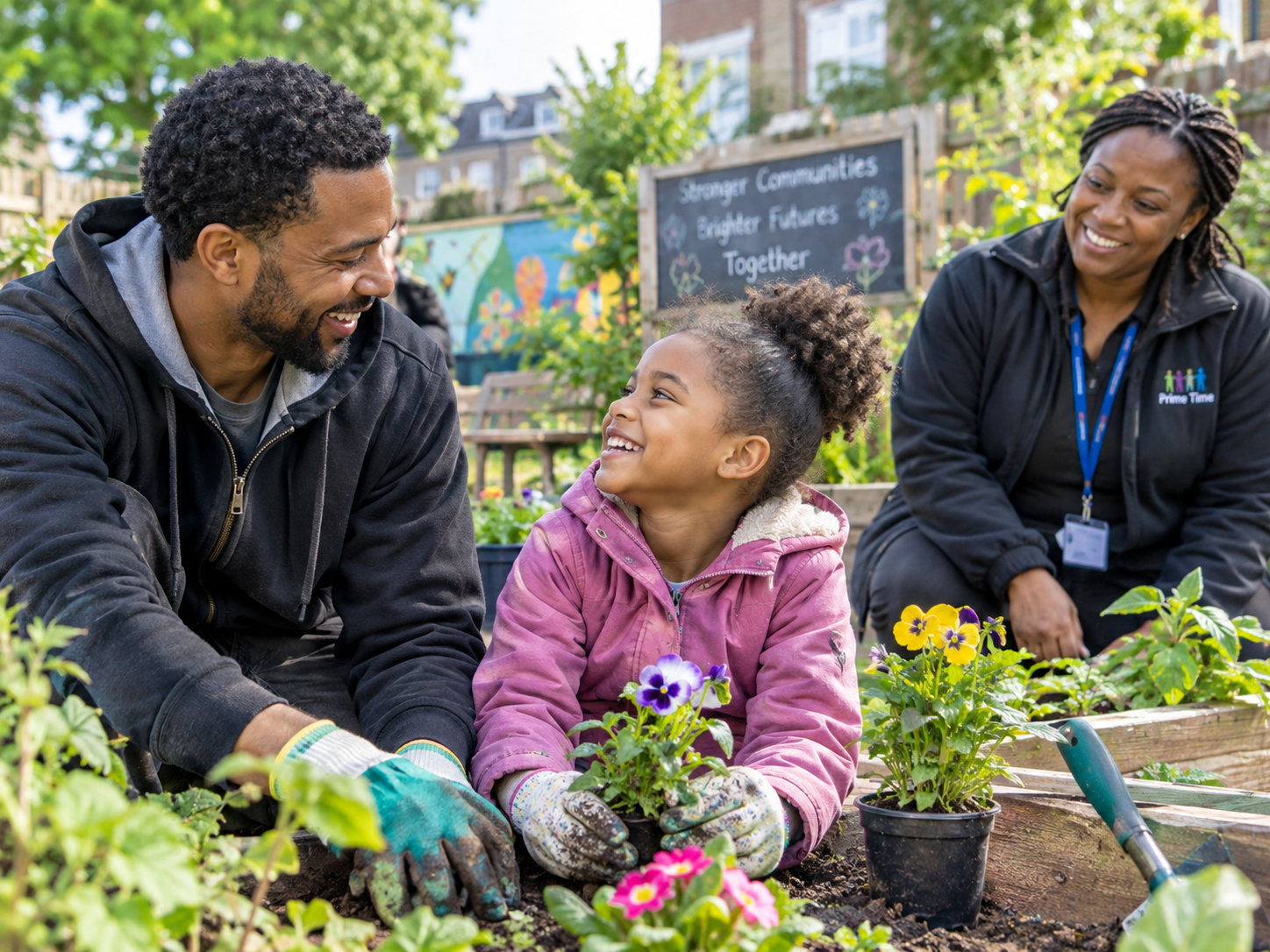
What is supervised contact in the community? It enables a child to spend meaningful time with a parent or relative in a real-world setting while a trained professional maintains everyone’s safety. Instead of meeting in an indoor room, families visit a park, garden or activity centre. At Prime Time Charity Services, our Supervised Child Contact Services help families do exactly that. Moreover, our Supported Child Contact Services offer a gentler step for families who need lighter oversight. This guide explains how community contact works and how your family can begin the process.
The Freedom of Outdoor Contact: Parks, Gardens, and Nature Spaces
Supervised contact outdoor activities and garden venues give children room to breathe. Open-air spaces make family visits feel normal. A child can kick a ball, feed the ducks or hunt for conkers with a parent beside them, which creates natural opportunities for connection. In contrast, a sterile office can feel like a test. Natural surroundings also reduce anxiety, because children relax considerably faster when they move, play and experience open space. As a result, conversation flows more easily, and parent and child can focus on each other. Our supervisors remain close enough to protect everyone, yet far enough to give the family privacy.
Activity Centres as Neutral Meeting Grounds: Empowering Kids to Choose
When a child or parent picks the activity centre, everyone gains a genuine sense of control. A local farm, a soft play area or a craft workshop all work well. Furthermore, a shared activity gives the family something to talk about, so the visit feels natural rather than like a formal assessment of parenting. For example, a child who loves animals may chat freely while feeding lambs. Our Supported Child Contact Services follow the same flexible approach.
Physical & Active Play
Many centres offer these energetic options:
- Multi-Level Soft Play Frames: Climbing structures, rope bridges and tunnels for older toddlers and children.
- Ball Pits and Arenas: Soft-ball throwing zones and large pits full of colourful balls.
- Slides and Roller Slides: Wave slides, spiral tube slides and wide multi-lane drops.
- Trampolines and Bouncy Beds: Mini trampolines and spring-loaded jump zones.
- Obstacle Courses: Soft foam balance beams, stepping stones and climbing blocks.
Parent and Carer Guide: Assessing Safety and Accessibility in Community Venues
How to choose a venue for supervised family contact starts with a simple checklist. Before you suggest a place, ask these questions:
- Does the venue offer a quiet, private zone where the family can talk?
- Can the supervisor see the family clearly, and can the public see them too?
- Is there a weather backup, such as a covered area or an indoor room?
- Can the supervisor stand close enough to hear and step in if needed?
- Is the venue easy to reach, and does it suit your child’s needs?
Additionally, look for toilets, baby-changing facilities and step-free access. If a venue ticks most boxes, put it forward. Then our team will review it with you.
Shifting from Indoor Rooms to Community Spaces: Why Flexibility Matters
Traditional indoor contact centres still serve many families well. However, community spaces offer extra benefits as children grow. A child can order a hot chocolate at a cafe or walk through a botanical garden with a parent. These small moments build confidence, independence and familiar routines. Meanwhile, a professional supervisor stays nearby the whole time. Consequently, families practise real parenting skills in real places.
Step-by-Step: How Families Can Propose and Arrange Community Contact
First, talk to your social worker or contact centre about your wishes. Next, think about your child’s age and interests. A toddler may enjoy a garden with a sandpit, while a teenager may prefer a craft workshop. Then suggest two or three venues and explain why each one fits. After that, our Supervised Child Contact Services team will research each venue and complete a detailed risk assessment. Finally, we agree a plan with everyone, and the first session begins. Throughout the process, we keep your child’s welfare and wellbeing at the centre. Supervised contact outdoor activities and garden venues often suit families well when the weather is kind.
Ready to Explore Community Contact?
Contact Prime Time Charity Services today. Call us on 0300 365 2700 or email at referral@ptccc.org.uk. Besides that, we can help you decide how to choose a venue for supervised family contact.
Frequently Asked Questions
Supervised contact in the community lets a child see a parent or relative in a public place, such as a park, garden or activity centre. A trained supervisor watches the visit and keeps the child safe. Our Supervised Child Contact Services use this model when it suits the family.
Public parks, botanical gardens, farms and nature trails all work well. Moreover, they help children relax. We check each venue for safety before a session starts.
Look for a private zone, good visibility and easy access. Also check for a weather backup and space for the supervisor to stand close. In addition, think about your child’s age and interests. Our team will help you decide.
Yes, in most cases. We encourage children and parents to suggest ideas, because choice builds confidence. Our Supported Child Contact Services also give families extra flexibility. However, a social worker may need to approve the final plan.
We always agree a weather backup in advance. For example, we may move the visit to a covered area, a cafe or an indoor room. Therefore, the session still goes ahead safely.
Related Posts


Contact Us
Prime Time Child Contact Centres
Norwood Picture House Library,
1-7 Norwood High St, Norwood,
London SE27 9JU,
Friends Meeting House,
Redlands Way,
London, SW2 3LU
0300 365 2700
referral@ptccc.org.uk


“Keeping children in touch with parents following separation”
