
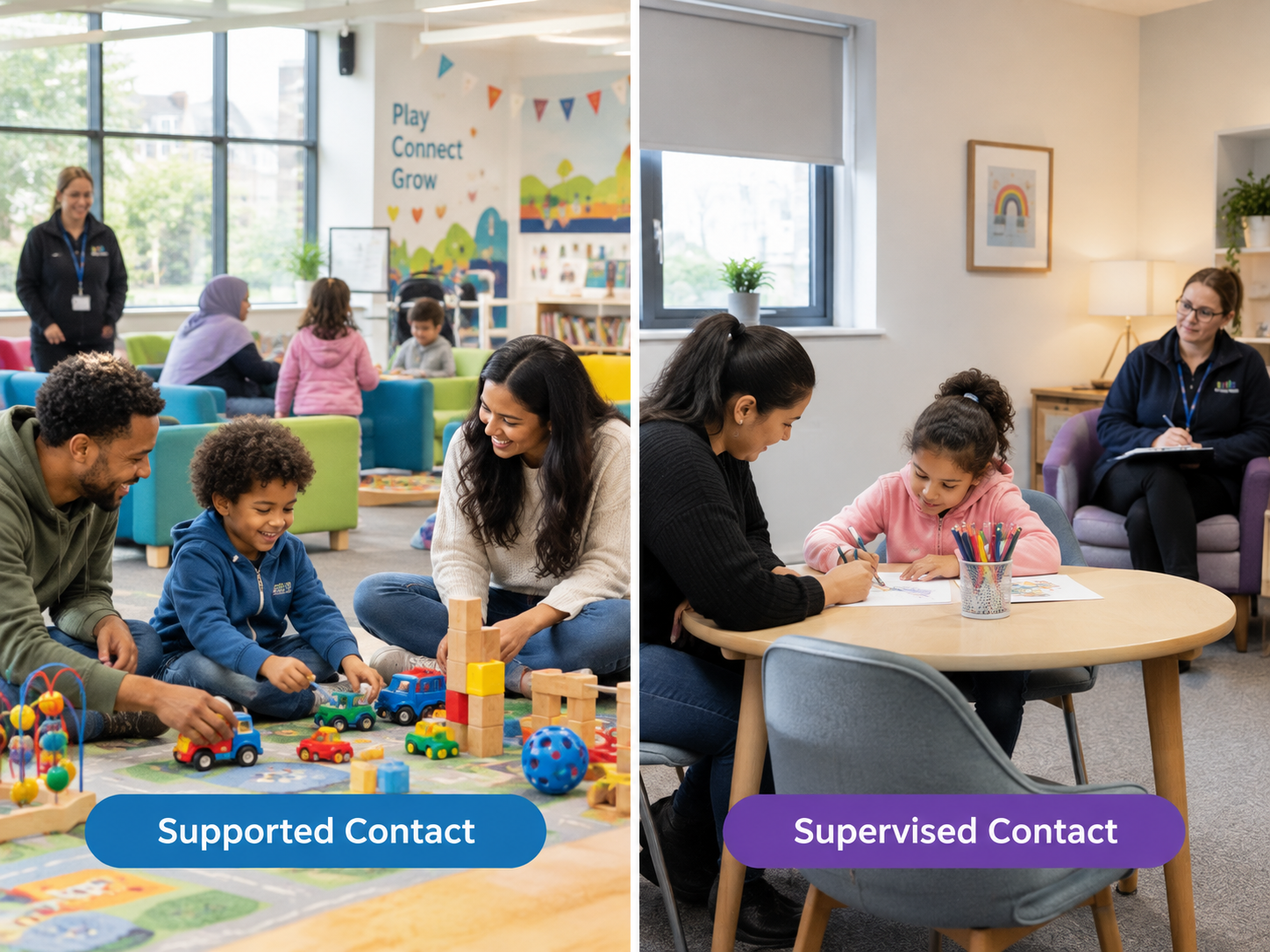
Separated families often ask us, “What is the difference between supported contact and supervised contact?” At Prime Time Charity Services, we offer both Supported Child Contact Services and Supervised Child Contact Services. However, the two options work very differently. In this post, we explain the difference between supported and supervised contact, so you can see which one suits your family.
Both services help children spend time with a parent in a safe setting. Trained supervisors watch over every session. Still, the level of support varies. Supported contact vs supervised contact comes down to the setting, the cost, the notes and the level of risk.
How supported contact works
Supported contact normally takes place in a large room with several families. The supervisors stay at the sidelines. They step in to help if they see anything concerning. They also step in when a parent asks them to. As a result, families enjoy a relaxed, open atmosphere.
Our Supported Child Contact Services run at weekends for about two hours. Also, this option costs considerably less, at £2.50 to £7.50 per hour. Therefore, many families find it a practical and affordable choice.
How supervised contact works
Supervised contact is a one-to-one session. Meanwhile, the family meets with an allocated supervisor. The supervisor observes the whole session and keeps a record of every conversation between the parent and child. Consequently, supervised contact gives closer oversight. Our Supervised Child Contact Services suit families who need that extra level of care.
Supported contact vs supervised contact: the key differences
Here is the difference between supported and supervised contact at a glance:
- Setting: Supported contact happens in a shared room, whereas supervised contact happens one to one.
- Cost and timing: In addition, supported contact costs £2.50 to £7.50 per hour and runs at weekends for about two hours.
- Notes: Supported contact provides no notes. In contrast, supervised contact produces notes.
- Supervisor role: In supported contact, supervisors wait at the sidelines. In supervised contact, the supervisor stays with your family throughout.
When supported contact is not suitable
Supported contact will not normally take place where material safeguarding concerns exist. For example, ongoing allegations of substance misuse or material mental health issues usually rule it out. In these cases, supervised contact offers a safer route. Every family’s situation differs, so we encourage you to talk to us about yours.
What happens to the resident parent?
In both services, the resident parent does not stay for the contact. However, the resident parent may attend the first session to settle the child. After that, the child spends the time with the other parent and our supervisors.
Which option is right for your family?
Therefore, think about your child’s needs, the level of any concern and your budget. Furthermore, remember that both options share one goal. Overall, they help children keep a safe bond with a parent. If you still wonder what is supported and supervised child contact in practice, our team will gladly talk it through.
Speak to Prime Time Charity Services today
Ready to take the next step? Call our friendly team on 0300 365 2700 or email at referral@ptccc.org.uk. We will explain each option clearly and help you choose the right service for your child.
Frequently Asked Questions
Supported contact takes place in a large room with several families. Supervised contact is a one-to-one session with an allocated supervisor. Also, supervised contact produces notes, whereas supported contact does not.
Both are safe contact services for children and parents. Prime Time Charity Services runs Supported Child Contact Services and Supervised Child Contact Services. Also, each one helps children spend time with a parent safely.
Supported contact costs between £2.50 and £7.50 per hour. It runs at weekends for about two hours. Therefore, it is the more affordable option.
Yes. The supervisor observes the session and keeps a record of every conversation between the parent and child. Supported contact provides no notes.
Supported contact will not normally go ahead where material safeguarding concerns exist. For example, ongoing allegations of substance misuse or material mental health issues rule it out. In these cases, supervised contact may suit your family better.
No. In both services, the resident parent does not stay. However, the resident parent may attend the first session to settle the child.
Your choice depends on your child’s needs, any safeguarding concerns and your budget. Therefore, contact our team to discuss the difference between supported and supervised contact for your situation.
Related Posts



Contact Us
Prime Time Child Contact Centres
Norwood Picture House Library,
1-7 Norwood High St, Norwood,
London SE27 9JU,
Friends Meeting House,
Redlands Way,
London, SW2 3LU
0300 365 2700
referral@ptccc.org.uk


“Keeping children in touch with parents following separation”
